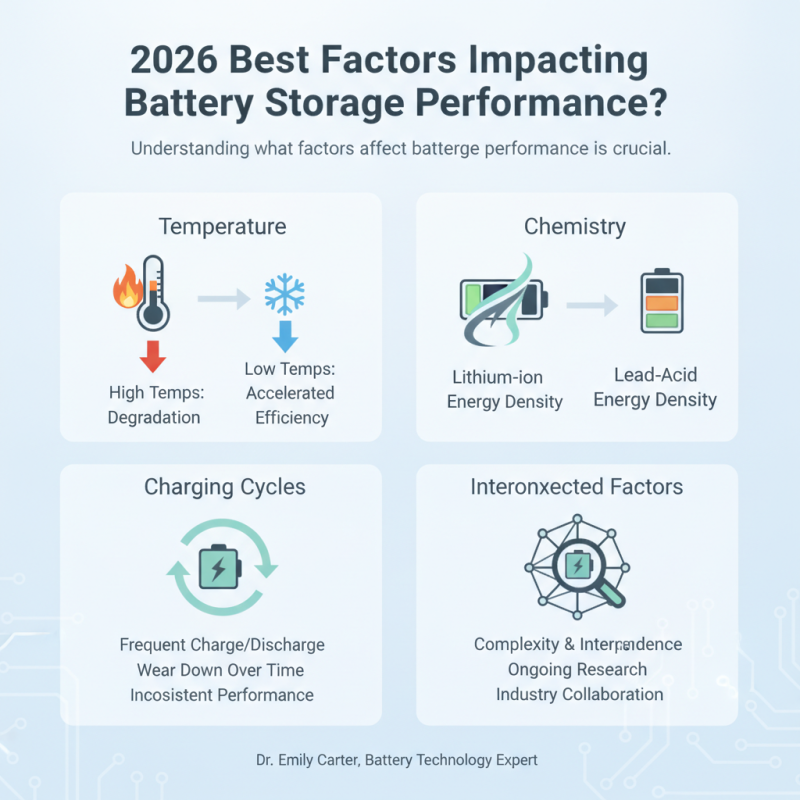
As the demand for energy storage grows, understanding "what factors affect battery storage performance" becomes crucial. Dr. Emily Carter, a leading expert in battery technology, states, "The efficiency of battery storage hinges on several key characteristics." This highlights the complexity of battery performance and the need for in-depth analysis.
Temperature plays a vital role in enhancing or diminishing battery life. High temperatures can accelerate degradation, while low temperatures may reduce efficiency. Additionally, the chemistry used in battery design significantly impacts performance. For instance, lithium-ion batteries typically offer better energy density compared to traditional lead-acid batteries.
Charging cycles also contribute to overall performance. Frequent charging and discharging can wear a battery down over time, which may lead to inconsistent performance. Many factors intertwine in this landscape, making it challenging to pinpoint a single influence. The pursuit of optimized battery storage solutions requires ongoing research and collaboration among industry experts.
Cycle life is a crucial factor impacting battery storage performance. It refers to the number of charging and discharging cycles a battery can undergo before its capacity significantly degrades. Various elements influence this cycle life, including temperature, depth of discharge, and charge/discharge rates. Understanding these factors can greatly enhance battery longevity.
Temperature plays a critical role. Extreme heat can accelerate degradation. Conversely, too much cold can hinder performance. Ideally, keeping batteries in a temperature-controlled environment helps maximize their lifespan.
Tip: Regularly check the operating temperature of your battery storage system.
Depth of discharge (DoD) also affects cycle life. Shallow discharges can prolong the battery's life, while deep discharges can shorten it. A consistent usage pattern is essential for maintaining optimal performance.
Tip: Aim to operate within recommended DoD levels for better cycle outcomes.
Charge/discharge rates impact cycle life as well. Faster charging can generate heat and lead to quicker wear. Finding a balance between efficiency and care is key.
Tip: Consider using a smart charging system that adapts to your battery's specific needs.
Temperature plays a crucial role in battery efficiency and longevity. Studies show that a rise in temperature can increase the rate of chemical reactions within batteries. However, exceeding optimal temperature ranges can lead to accelerated degradation. For instance, a report from the National Renewable Energy Laboratory highlights that lithium-ion batteries may lose 20% of their capacity over a five-year period if stored at 60°C compared to 25°C.
Maintaining appropriate temperatures is key for maximizing battery life. Batteries typically perform best between 20°C and 25°C. Operating outside this range can decrease overall efficiency, sometimes by as much as 30%. Extreme cold can slow down reactions, while heat can cause danger. As seen in several industry reports, managing temperature can enhance performance, leading to more reliable energy storage.
Tips: Monitor battery storage environments regularly. Use insulation in cold climates and venting in hot conditions. Also, consider thermal management solutions to maintain optimal temperatures. This approach can ensure your battery systems last longer and perform better. Balancing these temperature factors may require constant adjustments, but the end result is worth it.
Battery Management Systems (BMS) are critical in enhancing battery storage performance. They ensure that batteries operate within safe parameters, which is essential for longevity and efficiency. A well-designed BMS monitors the state of charge, temperature, and health of each cell. This monitoring prevents overcharging and overheating, two common pitfalls that can lead to significant capacity losses.
However, the effectiveness of a BMS depends greatly on the algorithms it employs. These algorithms process data in real-time, allowing for timely adjustments. Yet, it's not uncommon for BMS to struggle with unexpected conditions or nonlinear battery behavior, which can occasionally lead to inaccurate readings. Regular updates to these systems are vital, as they can improve accuracy and response time, reflecting ongoing research and technological advancements.
The integration of data analytics can also enhance the function of BMS. Analyzing historical usage patterns assists in predicting future performance and optimizing charge cycles. But, reliance on historical data can introduce risks, especially when usage patterns change. Thus, continuous evaluation and adaptation of BMS are necessary. Balancing performance and reliability remains an area for further development.
The charge and discharge rates significantly influence the energy efficiency of batteries. Higher charge rates can lead to increased energy losses due to heat generation. Studies show that charging a lithium-ion battery at rates above 1C can reduce its cycle life by up to 30%. This means that while quick charging is appealing, it can decrease the long-term performance of the battery.
Conversely, slow discharge rates can enhance energy retention. For example, discharging a battery at 0.5C allows for better thermal management and improved efficiency. Data indicates that such practices can optimize battery life by up to 20%, promoting sustainable usage. Yet, this approach may not suit all applications. The balance between speed and longevity remains a complex challenge.
Examining these factors reveals inconsistencies within battery technology. Many users may not be aware that the most efficient battery operation often requires compromise. Performance can vary greatly depending on usage patterns. These insights underline the necessity for ongoing research in energy efficiency and battery longevity. Adapting strategies to specific needs is essential for maximizing benefits.
As advancements in material science evolve, they are significantly reshaping battery technology. Innovations in lithium-ion chemistry, solid-state components, and nanomaterials are enhancing energy density and lifespan. For instance, research indicates that solid-state batteries could increase energy density by 30% compared to conventional lithium-ion cells. This shift opens new avenues for electric vehicles and grid storage systems.
Moreover, materials like graphene and silicon nanowires are becoming pivotal in battery design. Graphene can potentially double the charging speed while improving conductivity. Studies reveal that batteries incorporating silicon anodes can offer three times the capacity of traditional graphite anodes. However, challenges like thermal management and manufacturing scalability remain critical hurdles. Improving these aspects is essential for commercial viability.
The drive toward sustainable materials is also noteworthy. Using recyclable and abundant elements not only lowers costs but also reduces environmental impact. Reports show that transitioning to greener materials could cut battery production emissions by up to 50%. While the future looks promising, ongoing research is vital. Understanding these nuances will aid in developing more efficient and durable battery systems.
| Factor | Impact Level | Trends | Future Projections |
|---|---|---|---|
| Electrode Materials | High | Development of nanomaterials | Increased energy density by 30% |
| Thermal Management | Medium | Use of advanced cooling systems | Improved lifespan by 15% |
| Battery Management Systems | High | Integration of AI for predictive analytics | Increased safety and performance stability |
| Recycling Technologies | Medium | Enhancements in recovery rates | Reduction of raw material costs by 20% |
| Solid-State Batteries | Very High | Emergence of safe, high-performance alternatives | Potential to double battery lifespan |
: Cycle life refers to the number of charging and discharging cycles a battery endures before functionality declines.
Temperature impacts battery lifespan. Ideal temperatures range from 20°C to 25°C, balancing efficiency and longevity.
Depth of discharge indicates how much energy is used. Shallow discharges can prolong battery life, while deep ones can shorten it.
Regularly monitor battery temperature. Use insulation in cold regions and venting in hot climates to maintain optimal conditions.
Higher charge rates can generate heat, reducing cycle life. Lower rates may enhance efficiency and longevity, but compromise speed.
Yes, charging at high rates can lead to increased heat and decrease battery lifespan. A balance is essential.
Users often overlook that efficient operation requires compromises in speed and longevity. Continuous adjustment is key.
Battery technology shows inconsistencies. Research helps identify usage patterns and develop efficient strategies tailored to specific needs.
Following recommended DoD levels can significantly improve cycle outcomes, extending overall battery functionality.
Yes, extreme heat or cold can severely impact battery efficiency and safety. Managing these conditions is critical.
The article titled "2026 Best Factors Impacting Battery Storage Performance" delves into key elements that determine what factors affect battery storage performance. It examines the influence of cycle life and how factors such as temperature variations can significantly affect both the efficiency and longevity of battery systems. The integration of advanced Battery Management Systems (BMS) plays a crucial role in optimizing performance, ensuring batteries operate within ideal parameters to enhance their lifespan.
Additionally, the article discusses the effect of charge and discharge rates on energy efficiency, emphasizing how these rates can impact overall battery usability. Lastly, it highlights emerging trends in material science, which are paving the way for advancements in battery technology, ultimately leading to improved performance metrics. Each of these factors contributes to the broader understanding of optimizing battery storage solutions for the future.
